

EmailBison Pricing 2026: One Plan, One Price, One Buyer Profile
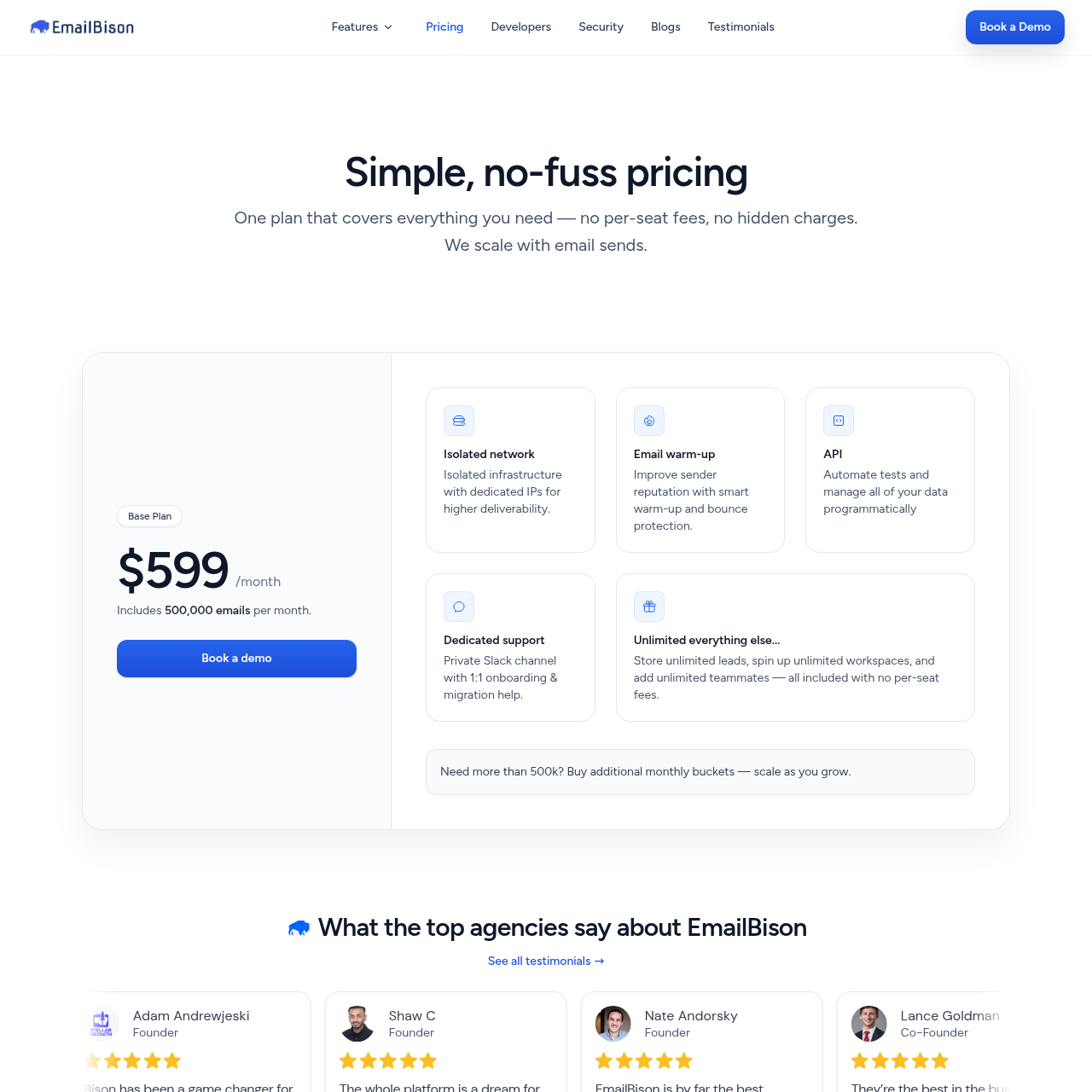
EmailBison publishes exactly one plan at $599/mo for 500K sends. The one-plan model signals what kind of buyer they want to serve. Here is how the bucket economics actually work.


Bottom line
EmailBison's pricing strategy is the most unusual in the cold email category: one published tier, one published price, one fixed capacity. $599/mo buys 500,000 emails per month with dedicated IPs, isolated VPCs, static egress, and private networking. There is no Starter, no Growth, no Pro, no negotiable ramp.
The decision to publish exactly one plan signals what kind of buyer EmailBison wants. The pricing page does not exist to explain what 500K emails costs or whether dedicated IPs are worth it; it exists to confirm a number for buyers who already decided they need this category of product. Casual evaluators bounce off the $599 anchor; committed buyers find it within their expected range.
The bucket model above 500K is strictly linear: each additional 500K is another $599. No volume discount, no commitment discount, no tier upgrade. Per-email cost stays at $0.0012 regardless of scale.
The trade-off: volumes below 500K per month carry a structurally bad per-email cost because there is no tier sized for modest infrastructure-quality needs. EmailBison either fits your scale or it does not.
EmailBison Plans
| Plan | Price | What you get | Watch out for |
|---|---|---|---|
| Standard single plan | $599/mo |
|
|
| Additional Volume volume buckets | $599 per additional 500K bucket |
|
|
EmailBison bucket math at various utilization levels
| Usage scenario | Monthly cost | Notes |
|---|---|---|
| Full bucket utilization (500K/mo) | $599/mo | Per-email cost: $0.0012. The intended utilization level. Pricing is competitive with comparable AWS SES rebuilds at this scale. |
| Half bucket utilization (250K/mo) | $599/mo | Per-email cost rises to $0.0024. You pay full capacity but use half. Workable but inefficient. |
| Light utilization (100K/mo) | $599/mo | Per-email cost: $0.006. Most teams at this volume should pick a tool designed for the volume tier rather than over-buying capacity. |
| Two buckets (1M/mo) | $1,198/mo | Per-email cost stays at $0.0012. No volume discount across buckets. |
| Five buckets (2.5M/mo) | $2,995/mo | Strictly linear scaling. Enterprise buyers above this volume should ask about negotiated rates explicitly; the public model has no published path. |
Why the single-plan model is intentional, not lazy
Most SaaS companies offer four or five published tiers to capture different buyer profiles. EmailBison offers one. The decision is strategic, not engineering laziness.
The single-tier model accomplishes three things. First, it filters out unqualified buyers at the top of the funnel; only buyers who need this category of product engage with the pricing page. Second, it sets a clear value anchor; there is no Starter to compare against, so the question is "is this product worth $599," not "should I pick Starter or Pro." Third, it simplifies sales conversations; the rep does not negotiate tier, only volume buckets.
The downside: teams whose actual need is 200K sends per month at premium infrastructure get no option from EmailBison. They either overpay for unused capacity or pick a different vendor. EmailBison is comfortable with this outcome; it is the intended customer-selection mechanism.
Key takeaways
- Filters unqualified buyers at the top of the funnel
- Anchors the value question as binary, not tier-relative
- Simplifies sales conversations to volume only
- Loses prospects whose needs are below the bucket size by design
How $599 compares to building the equivalent infrastructure yourself
The $599 fee covers infrastructure components that serious enterprise senders typically build themselves on AWS SES or similar: Dedicated IPs ($30-$80/mo per IP on AWS SES, plus reputation management overhead). Isolated VPC environment ($50-$200/mo for a proper VPC setup with security groups and routing). Static egress IPs (Elastic IPs at roughly $4/mo each plus NAT gateway costs).
Private networking (AWS PrivateLink at $0.01 per GB plus interface endpoints at $7.20/mo each). The deliverability tooling (warmup, master inbox, sequencer, AI tagging, EmailGuard placement testing) on top of the raw infrastructure. A self-built equivalent on AWS SES with all components typically lands at $1,500-$5,000/mo in pure infrastructure plus 1-2 engineer-quarters of build time and ongoing maintenance.
EmailBison's $599 packages the assembled equivalent into a managed service. For buyers who need exactly this infrastructure profile and do not want to build it, the math is favorable.
Key takeaways
- Self-built AWS SES equivalent: $1,500-$5,000/mo infrastructure
- Plus 1-2 engineer-quarters of build time
- Plus ongoing maintenance overhead
- EmailBison packages the equivalent for $599 managed
What you need to stack alongside EmailBison
EmailBison is the infrastructure layer. A complete outbound function needs a few more pieces. Common stacks include: Lead discovery: Apollo, Hunter, Clay, or Smartlead's SmartProspect.
Cost: $49-$200/mo depending on volume. Dialer: Aircall, JustCall, or a similar tool. Cost: $25-$100/mo per user.
ESP-aware routing: not commonly offered as a standalone tool; usually handled by sender-tool routing logic. EmailBison does not provide this natively. Blacklist monitoring: standalone tools like MXToolbox or HetrixTools.
Cost: $50-$150/mo. CRM: HubSpot, Salesforce, or Pipedrive via EmailBison's integrations. The full stack lands at EmailBison ($599) plus $200-$500 for the supporting tools.
For teams that prefer best-of-breed over consolidated, the stack approach makes sense. For teams that prefer one-tool consolidation, EmailBison is a structural mismatch with their preference.
Key takeaways
- EmailBison + lead discovery + dialer + monitoring + CRM is the typical stack
- Adds $200-$500/mo to the EmailBison base
- Best-of-breed approach favored by enterprise buyers
- One-tool consolidation buyers find EmailBison's scope too narrow
Keep reading
Got questions? We've got answers.
$599/mo for the single published plan. The plan covers 500,000 emails per month, dedicated IPs, isolated VPCs, static egress, and the full feature set. Additional volume is sold as 500K buckets at $599 each.
Ready to hit primary?
Set up SendKit's isolated infrastructure and start sending in under 15 minutes.
Dedicated IPs on every plan. Cancel anytime.