

Maildoso Pricing: What You Pay
Full breakdown of every Maildoso plan, mailbox type, and domain cost. Here is what you actually pay at scale and how it compares to InboxKit.


Bottom line
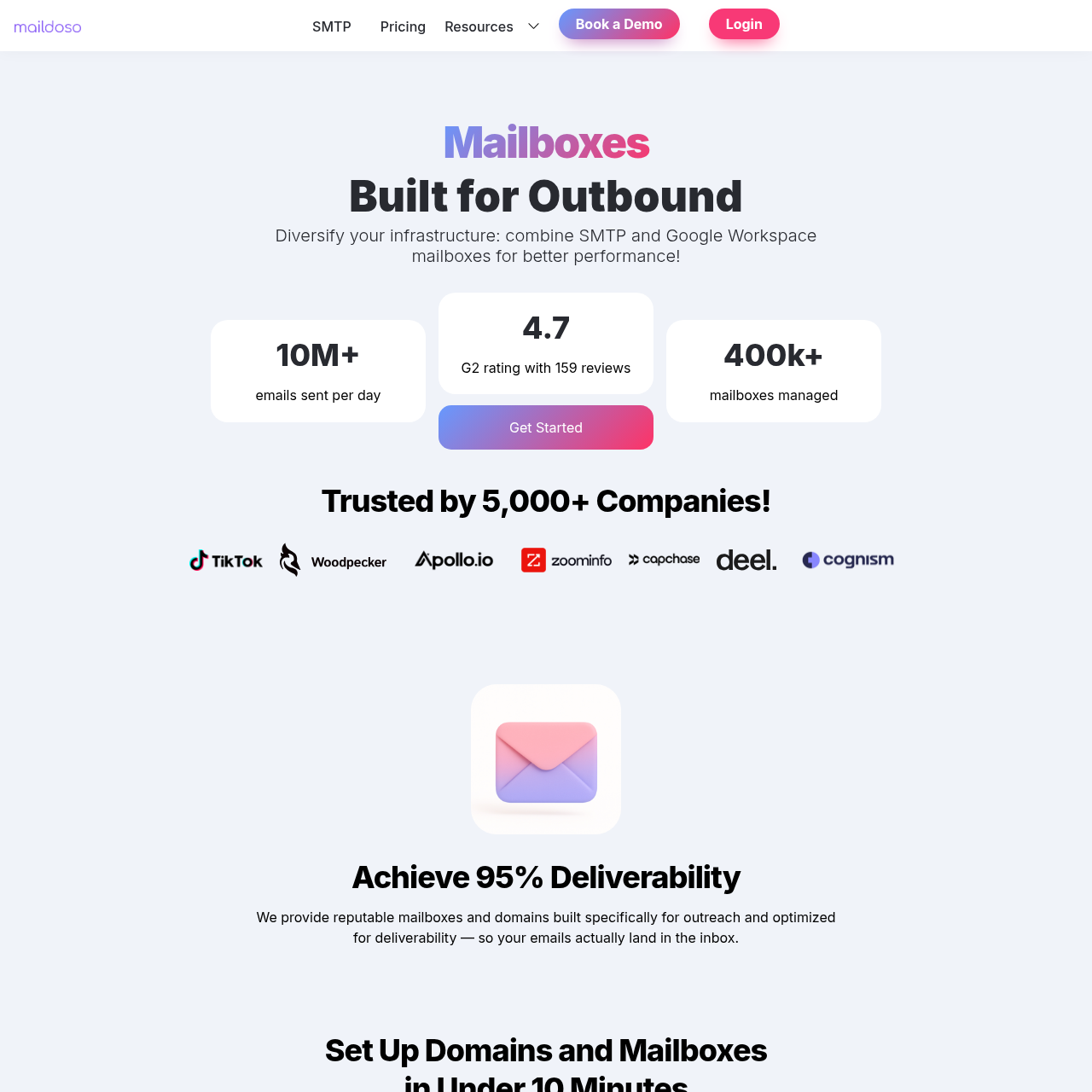
Maildoso is the volume specialist of the email infrastructure category. SMTP mailboxes from $1.90 each, Combo (SMTP + Google Workspace) from $2-$3, and domains from $2. The published rate is the cheapest in the category, and the operational track record (400,000+ mailboxes under management, 10M+ daily sends) backs the pricing with proven scale capacity that newer providers cannot demonstrate.
The deliberate choice is no bundled deliverability tooling: no warmup, no verifier, no placement testing, no blacklist monitor. The product is raw SMTP at a price designed to make 100-500 mailbox fleets economically viable, on the assumption that warmup and monitoring live in the sending platform on top.
Maildoso Plans
| Plan | Price | What you get | Watch out for |
|---|---|---|---|
| SMTP Mailboxes per mailbox | $1.90-$2.50/mailbox/mo |
|
|
| Combo (SMTP + GW) per mailbox | $2-$3/mailbox/mo |
|
|
| Domains per domain | From $2/domain |
|
|
Maildoso bill at typical fleet configurations
| Usage scenario | Monthly cost | Notes |
|---|---|---|
| 50 SMTP mailboxes, 10 domains | $115-$145/mo | 50 x $1.90-$2.50 + 10 x $2. Pure SMTP at lower volumes lands in the cheapest configuration in the category, assuming the sending platform handles warmup and monitoring. |
| 100 SMTP mailboxes, 20 domains | $230-$290/mo | 100 x $1.90-$2.50 + 20 x $2. The break-point where Maildoso's cost advantage over InboxKit ($250) inverts depends on whether your sending platform covers the deliverability gap. |
| 200 Combo mailboxes, 30 domains | $460-$660/mo | 200 x $2-$3 + 30 x $2. Combo (GWS-backed) at this volume is the sweet spot for teams wanting Google routing without paying retail GWS rates of $7/seat. |
| 500 SMTP mailboxes, 75 domains | $1,100-$1,400/mo | 500 x $1.90-$2.50 + 75 x $2. This is where Maildoso's scale story actually matters: provisioning, DNS automation, and ongoing fleet management on 500+ mailboxes is operationally heavy, and Maildoso's track record (400K+ mailboxes managed) provides the throughput. |
| 1,000+ mailbox fleet | $1,900-$2,500+/mo | Maildoso's claimed 10M+ daily send capacity is the relevant data point at this scale; the per-mailbox rate amortizes but operational continuity at this volume is the real question, and Maildoso has the longest track record in the category. |
The 400K-mailbox track record is the pricing premium that does not show on the page
Maildoso's public pricing is competitive on per-mailbox rate, but the more meaningful pricing story is operational: 400,000+ mailboxes under management and 10M+ daily sends processed. Most infrastructure providers in this category are newer (Mailforge, Infraforge, InboxKit, Zapmail all post-2022) and have not demonstrated continuity at this scale. Maildoso has been running provisioning, DNS automation, and fleet management at a scale where the failure modes have surfaced and been engineered around.
This matters because the failure modes of email infrastructure are not visible until volume reveals them: DNS propagation issues at high mailbox provisioning rates, IP pool degradation under multi-tenant load, MX record drift on dormant domains, capacity bottlenecks during industry-wide sending spikes. Newer providers can match Maildoso's sticker rate but cannot match the operational data on how the platform behaves under sustained 100K-1M-mailbox load. For a buyer making a multi-year infrastructure commitment, the track record is the cost of the unknown.
Maildoso's 4.7 G2 rating (159 verified reviews) is unusually high for the category and reflects the operational reality more than the headline price.
Key takeaways
- 400,000+ mailboxes under management
- 10M+ daily sends processed at platform scale
- 4.7 G2 rating from 159 verified reviews
- Operational track record newer providers cannot demonstrate
The SMTP-vs-Combo choice is the most-overlooked pricing lever
Maildoso's pricing publishes two tiers: pure SMTP ($1.90-$2.50) and Combo ($2-$3, SMTP plus Google Workspace). The naming undersells the impact. Pure SMTP runs through Maildoso's own sending fabric and lands in the inbox based on Maildoso IP reputation.
Combo mailboxes route through Google Workspace, which means the actual delivery path uses Google's MX servers and benefits from Gmail-to-Gmail inbox preference behavior. The deliverability differential is real but workflow-dependent. Sending to a B2B target list dominated by Google Workspace recipients, Combo typically lands 5-15 percent better in the inbox.
Sending to a mixed Microsoft 365 / corporate-IT-server list, the differential narrows or reverses. The 30-60 percent premium for Combo (typically $0.50-$0.80 more per mailbox) is worth it only when the recipient mix actually favors Google routing. The optimization most teams skip: run a 30-day deliverability test on a representative sample (say 5K sends each through SMTP and Combo) and pick the tier based on data, not assumption.
Most teams default to pure SMTP for cost and miss the placement gain; some default to Combo for reputation and overpay for routing they do not need.
Key takeaways
- Pure SMTP: Maildoso fabric, lower cost
- Combo: GWS routing, 5-15 percent better inboxing on GWS-heavy lists
- 30-60 percent cost premium for Combo over SMTP
- Pick the tier based on a recipient-mix test, not assumption
The MCP and API support is a pricing-relevant feature at scale
Maildoso ships API access and MCP (Model Context Protocol) support, which most competitors do not. At 50-mailbox scale, API access is a nice-to-have. At 500-mailbox scale, manual provisioning becomes operationally infeasible: every new domain, every mailbox naming convention, every DNS verification adds up to hours of clicking through panels.
The API and MCP integration are what make Maildoso's scale claim (400K mailboxes managed) credible for individual large customers. The pricing-relevant implication: a 500-mailbox fleet on Maildoso can be provisioned in a few hours of scripting. The same fleet on a provider without API access is days of manual work plus ongoing fleet-management overhead.
The cost of operator time at $80-$150/hour quickly exceeds the per-mailbox savings if the alternative provider is API-less. For agencies and large in-house teams modeling total cost, this is the line item that does not appear on the pricing page but determines real-world economics at the high end of the scale range.
Key takeaways
- API and MCP support for automated provisioning
- Critical at 500+ mailbox scale where manual is infeasible
- Operator time savings can exceed per-mailbox cost differential
- A pricing factor that does not appear on the public sticker
When Maildoso is structurally the right pricing choice
Maildoso fits cleanly when three conditions hold. First, your sending platform already covers warmup, validation, placement testing, and blacklist monitoring; the savings on raw mailboxes is genuine because you are not buying duplicate deliverability tooling. Second, your volume is high enough that the per-mailbox rate difference materially matters; under 30-50 mailboxes the absolute dollars are too small to justify a separate infrastructure choice.
Third, you value operational continuity at scale over the pricing model of a newer provider with comparable rates. Maildoso does not fit cleanly when those conditions invert. Teams running barebones sequencers without deliverability tooling pay the gap to InboxKit and get the bundle.
Teams running small fleets pay the same amount across any provider. Teams comfortable with newer providers can match Maildoso's rate at Mailforge ($2-$3) or beat it on bundled value at InboxKit ($2.50). The selection question is which trade-off matches the operating model.
Key takeaways
- Best fit: sending platform covers deliverability, high mailbox volume
- Poor fit: small fleets, no separate deliverability tooling
- Trade-off: cheapest rate vs bundled deliverability stack
- Operational track record favors large-scale commitments
Keep reading
Got questions? We've got answers.
When your sending platform does not already cover warmup, verifier, placement testing, and blacklist monitoring. Sourcing those standalone runs $75-$200/mo regardless of mailbox count, which erodes the per-mailbox savings versus a bundled provider. At 100 mailboxes, raw Maildoso ($190) plus standalone tooling ($75-$150) lands at $265-$340, vs InboxKit at $250 all-in.
Ready to hit primary?
Set up SendKit's isolated infrastructure and start sending in under 15 minutes.
Dedicated IPs on every plan. Cancel anytime.