
 vs
vs
Woodpecker vs EmailBison (2026): Per-Prospect Sequencer vs Workspace Infrastructure
Woodpecker charges per contacted prospect with every feature included at the low end. EmailBison charges one workspace fee for premium infrastructure at the high end. Opposite ends of the pricing spectrum.

The Verdict
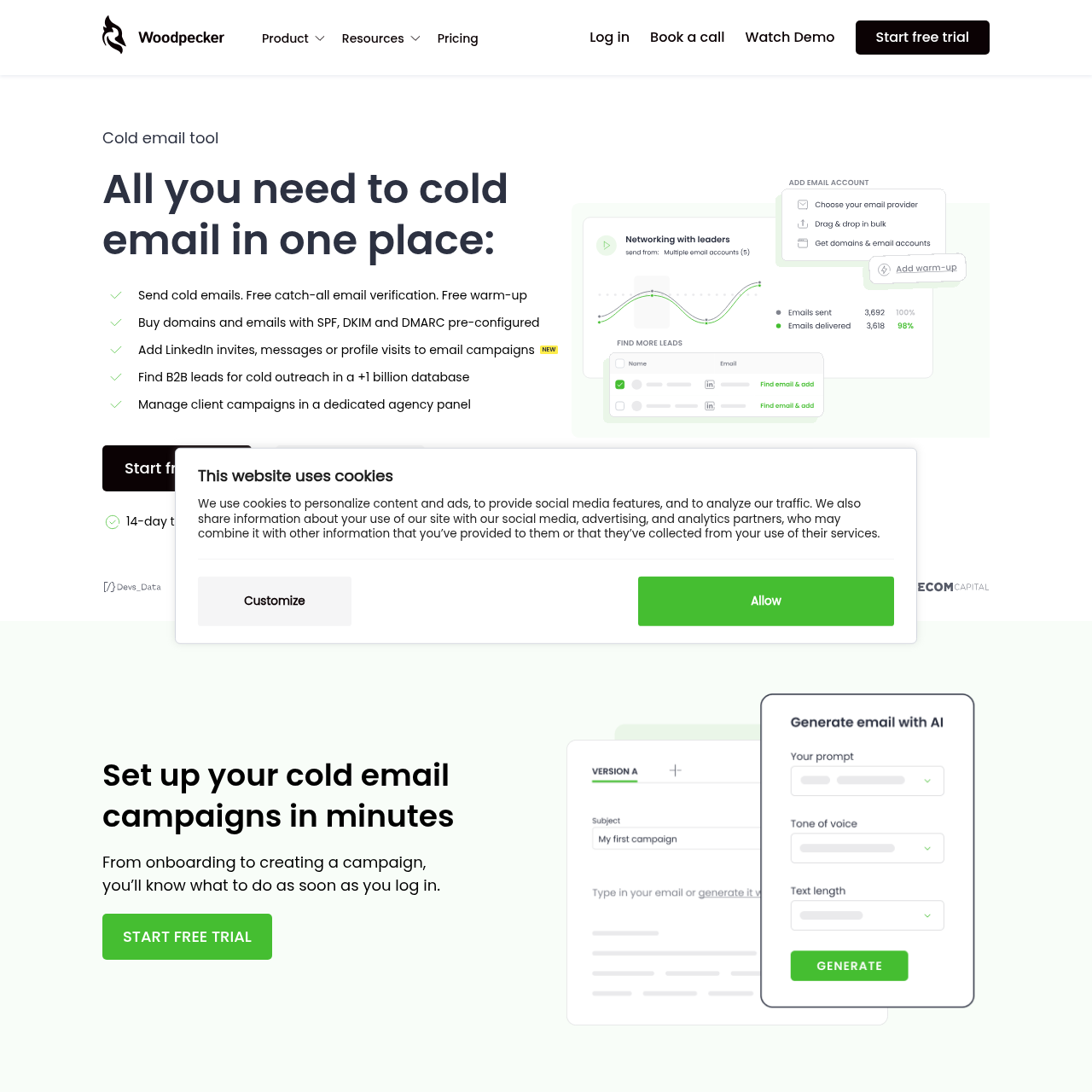
Woodpecker and EmailBison occupy opposite poles of the cold email pricing spectrum and serve buyers with opposite priorities. Woodpecker charges $29 for 500 contacted prospects per cycle, with every feature (A/B testing, conditional logic, manual task steps, Bounce Shield verification, agency panel) included at every tier. The pricing rewards careful, deep sequencing on small lists.
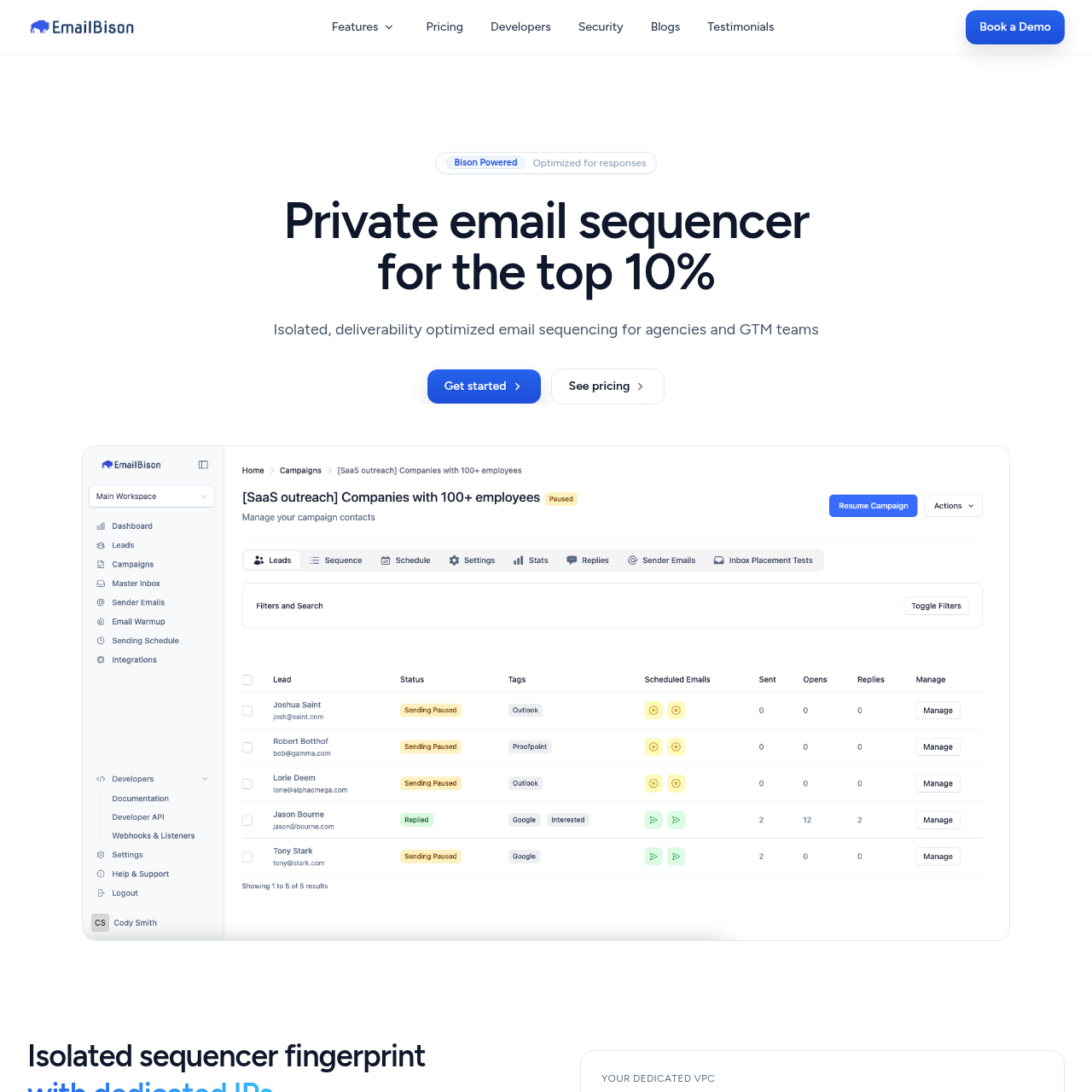
EmailBison charges $599/mo for one plan with dedicated IPs, isolated VPCs, static egress, and private networking, with the sequencer functional but secondary. The pricing rewards committed enterprise senders with operator-led workflows at meaningful volume. A founder running ABM outbound to 200 named accounts buys Woodpecker because the deep-sequence depth matches the workflow and the cost is low.
A growth-stage enterprise team running 500K sends per month with compliance requirements buys EmailBison because the bundled infrastructure isolation justifies the spend. Neither product is the right answer for the other's buyer; the comparison is mostly useful for filtering out the wrong product for your context.
Woodpecker vs EmailBison: Feature-by-Feature
| Feature | Woodpecker | EmailBison |
|---|---|---|
| Infrastructure | ||
| Dedicated IPs | No No dedicated IP option | Yes Dedicated IPs included on the $599/mo plan |
| Isolated Infrastructure | No Shared infrastructure | Yes Isolated VPCs with static egress |
| Email Warmup | Yes Warmup included on all plans | Yes Email warmup included |
| Email Verification | Built-in List verification before sending | No No standalone verification tool mentioned |
| Blacklist Monitoring | No No blacklist monitoring | No No blacklist monitoring |
| Pricing | ||
| Starting Price | $29/mo Cold Email plan: 500 contacted prospects | $599/mo Single plan: 500K emails, dedicated IPs |
| Sending | ||
| Monthly Prospects | 500 to 25K+ 500 on Cold Email ($29), scaling on higher tiers | Unlimited Unlimited leads and contacts |
| Features | ||
| Lead Database | No No built-in lead finder | No No lead finder |
| Built-in Dialer | No No built-in dialer | No No built-in dialer |
| CRM | No No built-in CRM | No No built-in CRM |
| Scale | ||
| Agency Features | Agency plan Multi-client management on Agency plan | No No agency features |
The per-prospect meter is Woodpecker's defining quirk
Woodpecker meters on contacted prospects per month, not emails sent. A "contacted prospect" is a unique person you have touched in a sequence; once you hit that prospect, follow-up steps (second email, third email, fifth-step manual task) cost nothing extra against the meter. This pricing model rewards deep sequences on narrow lists: a 500-prospect month with a six-step sequence costs the same $29 as a 500-prospect month with a one-step sequence.
The cap is the headcount you reach, not the volume you send. EmailBison meters on raw email volume in 500K-send buckets. A 500K-email month is $599 whether it goes to 5,000 prospects with 100 touches each or 500,000 prospects with one touch each.
The cap is the volume you push through the engine. The two meters are designed for opposite workflows. A founder running ABM into 200 named accounts with eight-touch sequences hits Woodpecker's sweet spot because the deep sequencing comes free.
A growth team blasting 100K emails per month to fresh lists hits EmailBison's sweet spot because the volume comes with the included infrastructure. Cross the wrong meter and the bill becomes nonsensical: ABM on EmailBison wastes 95 percent of the 500K bucket; high-volume on Woodpecker burns through the prospect cap in week one.
Key takeaways
- Woodpecker meter: contacted prospects per month
- EmailBison meter: emails sent in 500K-send buckets
- Deep sequences on small lists fit Woodpecker
- High-volume single-touch fits EmailBison
Where each pricing meter actually breaks for buyers
Woodpecker's meter breaks at two thresholds. First, when prospect volume grows past 5,000-10,000 per month, the tier ladder ($29 to $80 to $103+) climbs faster than the value of the bundled feature set, and most teams migrate off to a volume-priced sequencer. Second, when a team's sequence depth drops to one or two emails per prospect, Woodpecker's pricing model loses its advantage because the "follow-ups are free" benefit no longer applies.
EmailBison's meter breaks at the bottom: teams sending under roughly 150K-200K emails per month are wasting 60-70 percent of the 500K bucket because the floor is the same as the ceiling at that tier. There is no $299 or $399 entry tier; the only published option is $599 for 500K. A team running 50K-100K monthly sends is paying $0.006-$0.012 per email when the bucket's amortized rate would be $0.0012 at full utilization.
For a buyer modeling spend, the question is which meter's break-point is closer to your operating reality. Below 5K prospects with deep sequences: Woodpecker. Above 200K monthly sends with shallow sequences: EmailBison.
Anywhere in between: neither product is actually optimized for you.
Key takeaways
- Woodpecker meter degrades past 5K-10K prospects
- Woodpecker meter degrades when sequences are 1-2 touches
- EmailBison meter wastes 60-70 percent on sub-200K-send months
- Mid-range workloads sit awkwardly on both pricing models
Everything-included (Woodpecker) vs minimal-and-isolated (EmailBison)
Woodpecker bundles the full operator feature set into every tier: A/B testing, conditional sequence branching, manual task steps, Bounce Shield list verification, adaptive sending pace, the agency panel for sub-account management. The pricing is small but the sequencer surface is mature. The trade-off is that the underlying infrastructure is shared and there is no dedicated-IP upgrade path.
EmailBison bundles the opposite: minimal sequencer surface (A/B, conditional, master inbox, AI reply tagging), no agency panel, no manual task steps, no native LinkedIn or dialer. What you pay for is the network layer: isolated VPCs, dedicated IPs, static egress, private networking, EmailGuard placement testing. The sequencer is functional but is not where the money went.
The philosophical split: Woodpecker prices the sequencer richly and assumes shared infra is good enough; EmailBison prices the infra richly and assumes a minimal sequencer is good enough. Neither answer is wrong; they reflect different beliefs about which layer of the stack is the bottleneck.
Key takeaways
- Woodpecker: mature sequencer, shared infrastructure
- EmailBison: minimal sequencer, isolated infrastructure
- Different beliefs about where the cold email bottleneck is
- Choose by which layer constrains your campaigns
Why agencies pick Woodpecker and growth teams pick EmailBison
Woodpecker's agency panel is one of the oldest and best-developed in the category. Sub-accounts with isolated client views, per-client billing, white-label reporting, multi-client deliverability monitoring. The pricing model (per contacted prospect) also works in an agency's favor because most agency client campaigns are deep sequences on bounded lists, which is exactly what Woodpecker's meter rewards.
EmailBison has no native agency panel. White-label branding is available, but there is no sub-account architecture, no per-client billing, no isolated client workspace within one account. Agencies running EmailBison typically provision separate workspaces per client at $599 each, which gets expensive fast (five clients = $2,995/mo just for infrastructure).
Growth-stage in-house teams pick EmailBison because the workflow is one campaign, one infrastructure footprint, and pure volume matters more than client segmentation. Agencies pick Woodpecker because the workflow is many clients with bounded campaigns, and per-prospect metering plus sub-account tooling fit the business model.
Key takeaways
- Woodpecker agency panel: sub-accounts, client billing, white-label
- EmailBison: no native agency panel, just white-label branding
- Five-client agency on EmailBison = $2,995/mo in workspaces
- Pricing model alignment matters as much as feature alignment
Pros & Cons
Woodpecker
Strengths
- Simple and affordable at $29/mo
- Clean interface with quick onboarding
- Built-in email verification and bounce shield
- Agency plan for multi-client management
- Adaptive sending to protect reputation
Limitations
- Shared infrastructure on all plans
- No dedicated IP option
- No lead finder or database
- No built-in dialer or CRM
- Limited to 500 prospects on the starter plan
EmailBison
Strengths
- Dedicated IPs and isolated VPCs included
- Static egress and private networking
- EmailGuard inbox placement testing
- Unlimited leads, workspaces, and teammates
- Dedicated Slack support
Limitations
- Single plan at $599/mo with no lower-tier option
- No lead finder or prospecting database
- No built-in dialer or CRM
- No blacklist monitoring or ESP matching
Got questions? We've got answers.
One tick on the meter per unique person you sequence in a month, regardless of how many follow-up steps that sequence contains. A six-step sequence to 500 prospects costs the same $29 as a one-step blast to 500 prospects. The model rewards depth; touching the same person again next month costs another tick.
Ready to hit primary?
Set up SendKit's isolated infrastructure and start sending in under 15 minutes.
Dedicated IPs on every plan. Cancel anytime.